

Bridge foundations are critical for ensuring the stability and longevity of a bridge. They are designed to transfer the loads of the bridge and its traffic to the ground. There are several types of bridge foundations, and they are typically selected based on the type of soil, the depth of bedrock, and the design of the bridge. Here are the main types of bridge foundations:
1. Shallow Foundations
Shallow foundations are used when the soil near the surface is strong enough to support the loads of the bridge. They are generally less expensive and easier to construct. Types include:
- Spread Footings (Slab and Slab-Strip Foundations): A wide base of concrete or masonry that spreads the load from the bridge pier across a large area.
- Slab Foundations: A large, flat base that distributes the load over a wide area.
- Raft Foundations (Mat Foundations): A large concrete slab that supports multiple piers or columns, spreading the load evenly across the foundation.
2. Deep Foundations
Deep foundations are used when the soil near the surface is weak, or when the bridge needs to be supported by deeper, stronger layers. They transfer the load to deeper, more stable soil or bedrock. Types include:
- Piles: Long, slender columns made of concrete, steel, or timber, driven into the ground to reach stable soil or bedrock. There are several types of piles:
- End-bearing Piles: Transfer load directly to bedrock or dense soil at the bottom of the pile.
- Friction Piles: Transfer the load through friction between the surface of the pile and the surrounding soil.
- Combination Piles: Use both end bearing and friction for load transfer.
- Caissons (Drilled Shafts or Cofferdams): Large cylindrical structures that are constructed in place and used for deep foundations. They are usually sunk into the ground or underwater to reach stable soil or bedrock.
3. Pier Foundations
Pier foundations are vertical structures, typically made of concrete or masonry, that extend into the ground to transfer the load from the bridge. There are a few variations of pier foundations:
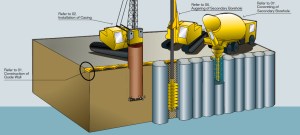
- Bored Piles: Holes are drilled into the ground, and the pile is then cast in place.
- Cylindrical Piers: Large, cylindrical concrete structures that support bridge piers. These can either be cast-in-place or precast.
4. Floating Foundations
Floating foundations are used in areas with weak soil or in water bodies where the structure can “float” on the surface or on the seabed, reducing the impact of settlement.
- Pontoon Foundations: Floating foundations used in marine or river bridges, where a large platform or pontoon floats on water and supports the bridge structure.
5. Well Foundations
Well foundations are used in situations where piers need to be built in water, such as for bridges over rivers or other bodies of water. They consist of large, hollow concrete structures that are sunk to the desired depth, with the interior excavated to make the structure stable.
Each type of foundation is selected based on the specific conditions of the site, including the nature of the soil, the water table, the loads expected on the bridge, and the bridge’s design.



 Civil Insight
Leave a comment