

Secant piles are interlocking concrete piles constructed to form a continuous wall, typically used as a retaining system in deep excavation projects. These piles are built by alternating two types of piles:
Primary (soft) piles: typically made of a weaker concrete mix, often unreinforced or lightly reinforced.
Secondary (hard) piles: constructed between primary piles, often with structural reinforcement and higher-strength concrete.
The term “secant” refers to the way the piles intersect or cut into one another. The overlap ensures minimal water ingress and improved wall strength.
Secant pile walls are commonly used for:
– Deep basements in urban areas
– Tunnels and shafts
– Foundations near existing structures
– Groundwater cutoff walls
Advantages of Secant Pile Walls
Water Tightness: Provides effective control against groundwater ingress.
Versatility: Can be used in various soil conditions.
Structural Strength: Can support significant loads and lateral pressures.
Low Vibration: Suitable near sensitive structures due to minimal ground movement.
Space Efficiency: Ideal for constrained sites where open cut excavations aren’t feasible.

Step-by-Step Construction Process
The process of constructing secant piles is meticulous and involves careful planning, precise engineering, and thorough execution. Below is a breakdown of the process into key stages:
1. Site Investigation and Geotechnical Analysis
Before any design or construction begins, a comprehensive site investigation is essential.
Soil Testing: Boreholes, standard penetration tests (SPT), cone penetration tests (CPT), etc.
Groundwater Levels: Understanding the water table is crucial for dewatering and concrete selection.
Obstruction Mapping: Detection of utilities, boulders, or foundations that may obstruct piling.
The results inform the pile diameter, spacing, depth, and reinforcement design.
2. Design of the Secant Pile Wall
Key design considerations include:
Pile Diameter and Overlap: Typically, overlap ranges between 100–150 mm.
Spacing: The center-to-center spacing is generally 75–90% of the pile diameter.
Wall Thickness: Determined by excavation depth and load requirements.
Reinforcement Design: Secondary piles are reinforced based on bending moments and shear forces.
Structural and Geotechnical Analysis: Performed using FEM software to simulate earth pressures, water loads, and soil-structure interaction.
The wall may be temporary or permanent, influencing design loads and durability considerations.
3. Surveying and Layout
Once the design is finalized, precise layout and surveying begins. Marking Pile Centers: Using total stations or GPS-enabled robotic systems. Setting Alignment: Reference points or guide walls may be installed to ensure straightness. Accurate setting out is critical for avoiding misalignment, which can compromise the wall’s integrity.
4. Guide Wall Construction (Optional)
In many cases, especially for deep or long secant walls, a guide wall is constructed:
Material: Typically, low strength concrete.
Dimensions: 500–800 mm deep and 300–500 mm wide.
Purpose: Assists in aligning the drilling equipment and ensuring verticality of piles.
5. Drilling Primary (Soft) Piles
The construction starts with the primary piles:
Drilling Equipment:
Continuous Flight Auger (CFA)
Rotary rigs with casing oscillators
Kelly bar drilling
Pile Diameter: Commonly ranges between 600 mm to 1200 mm.
Depth: Typically extends below the base of the excavation (toe embedment), sometimes 15–30 m deep.
After reaching the required depth, the bore is filled with low-strength concrete (often 15–20 MPa). Reinforcement may or may not be installed depending on design.
Each primary pile is allowed to cure for 24 to 72 hours, ensuring it gains enough strength to resist collapsing when the adjacent pile is drilled.
—
6. Drilling Secondary (Hard) Piles
The secondary piles are drilled between the primary piles, cutting into them to create the interlock.
Cutting Overlap: 100–150 mm of the adjacent primary piles are overlapped.
Concrete Strength: Typically 30–40 MPa to serve structural and watertight functions.
Reinforcement: Full cages or steel sections (I-beams, cages) are inserted.
Drilling into partially cured concrete demands specialized tooling and experienced operators to maintain interlock quality.
7. Reinforcement Cage Installation
For structural secondary piles:
Cage Fabrication: Prefabricated cages are brought to site or tied manually.
Placement: Lowered using cranes with centralizers to maintain position and verticality.
Depth Control: Cage is positioned to required depth with adequate cover to avoid corrosion.
If the reinforcement includes couplers or splices, precision in fabrication and placement is vital.
8. Concrete Pouring
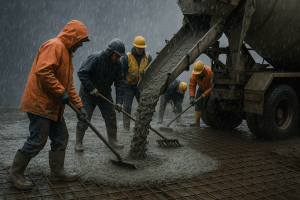
After drilling and cage placement, concrete is placed via tremie methods or directly from the truck mixer (for dry bores):
Tremie Pipe: Used when groundwater is present, ensuring concrete placement from the bottom up.
Concrete Quality: Needs to be workable and flowable with minimal segregation.
Slump and Cube Testing: Quality control includes slump flow and compressive strength tests.
Continuous Pour: To avoid cold joints and maintain homogeneity.
For CFA methods, concrete is pumped through the auger stem as the auger is withdrawn.
9. Trimming and Top Preparation
Once the piles are cured:
Trimming: Excess concrete above cut-off level is removed (often 300–600 mm).
Cleaning Rebars: Any reinforcement exposed must be cleaned for bonding with capping beams or slabs.
Verticality and Diameter Check: Borehole deviation records and sonic logging can be used for QA.
10. Capping Beam Construction (If Required)
To ensure structural integrity and alignment:
Capping Beam: A reinforced concrete beam cast across the pile tops.
Function: Distributes loads, aligns top elevations, and provides connection for slabs/walls.
Shuttering and Pouring: Standard concrete formwork and placement methods.
11. Excavation and Monitoring
Once the wall is in place:
Excavation Begins: Can proceed in stages with temporary supports like struts or anchors.
Instrumentation: Inclinometers, piezometers, load cells, etc., are installed to monitor wall performance.
Groundwater Control: Dewatering may be employed, especially if the secant wall acts as a cut-off wall.
Throughout excavation, performance of the secant wall is monitored to detect movements or water ingress.
Quality Control Measures
Ensuring quality in secant pile construction involves:
Borehole Deviation Checks: Using inclinometers or drilling logs.
Concrete Testing: Slump, flow table, and compressive strength.
Overlap Verification: Site logs, operator notes, and post-drilling photos.
Verticality Tolerance: Typically 1:200 but project-specific
Integrity Testing: Crosshole Sonic Logging (CSL) or low-strain integrity tests.
—
Challenges and Considerations
1. Pile Alignment
Misalignment of even a few centimeters can disrupt the interlock, causing gaps or weak spots.
2. Ground Conditions
Soft or collapsing soils can complicate drilling and concrete placement.
3. Water Ingress
If pile overlap is insufficient or poor-quality concrete is used, water can seep through.
4. Construction Tolerances
Maintaining tolerances in urban environments with traffic, space limitations, and existing utilities is challenging.
5. Equipment Limitations
Large rigs may not be able to access restricted sites, and specialized tooling may be required.
Real-World Example: Urban Basement in Sydney, Australia
In 2023, a multi-storey basement was constructed in Sydney’s CBD adjacent to heritage structures. Due to limited space and high groundwater, secant pile walls were selected for excavation support.
Highlights:
1000 mm diameter piles, 1200 mm c/c spacing
Depth of 22 meters with 4.5 meters of toe embedment
Reinforced secondary piles with 32 MPa concrete
Guide walls used to ensure alignment
Instrumentation included piezometers and inclinometer casings
Result: No significant ground movement or water ingress was reported during excavation
Alternatives to Secant Piles
Depending on the project, other wall systems may be considered:
Contiguous Pile Walls: Gaps between piles; not watertight.
Diaphragm Walls: Slurry trench method; suitable for very deep excavations.
Sheet Piles: Quick and reusable; limited in depth and strength.
Soldier Piles and Lagging: Effective in dry, stable soils.
Secant piles are often preferred for complex, high-stakes environments where strength and water cut-off are both critical.
Conclusion
Secant pile walls represent a sophisticated and highly effective solution for deep excavation support and groundwater control in urban construction. The process—from design and layout to drilling, reinforcement, and concrete placement—demands precision and expertise. While the method involves higher costs compared to simpler techniques, the benefits in structural reliability, water control, and adaptability make it a sound investment in many geotechnical contexts.
For engineers, contractors, and stakeholders involved in large-scale infrastructure or high-rise development, understanding the intricacies of secant pile construction is invaluable.
Want to learn more about deep foundation techniques or explore case studies? Subscribe to our blog for updates on the latest in civil and geotechnical engineering!


 Civil Insight
Leave a comment