

Concrete performance is strongly influenced by environmental conditions at placement and during early curing. Rain, wind, extremes of temperature and humidity each introduce distinct failure mechanisms (increased effective w/c, plastic shrinkage, freeze damage, and surface washout). Compliance with guidance such as ACI 305R, ACI 306R, ASTM C94, EN 206 and AS 1379 / AS 3600 is essential to mitigate these risks.
Weather effects and technical mechanisms
Rain
Rain during placement increases the effective water–cement ratio and can create surface washout and laitance. Even small increases in w/c (≈ +0.05) correspond to notable strength reduction (~10%). Limit pours during rainfall > 3 mm/hr where practicable, or provide continuous overhead protection and positive drainage.
Hot weather & wind
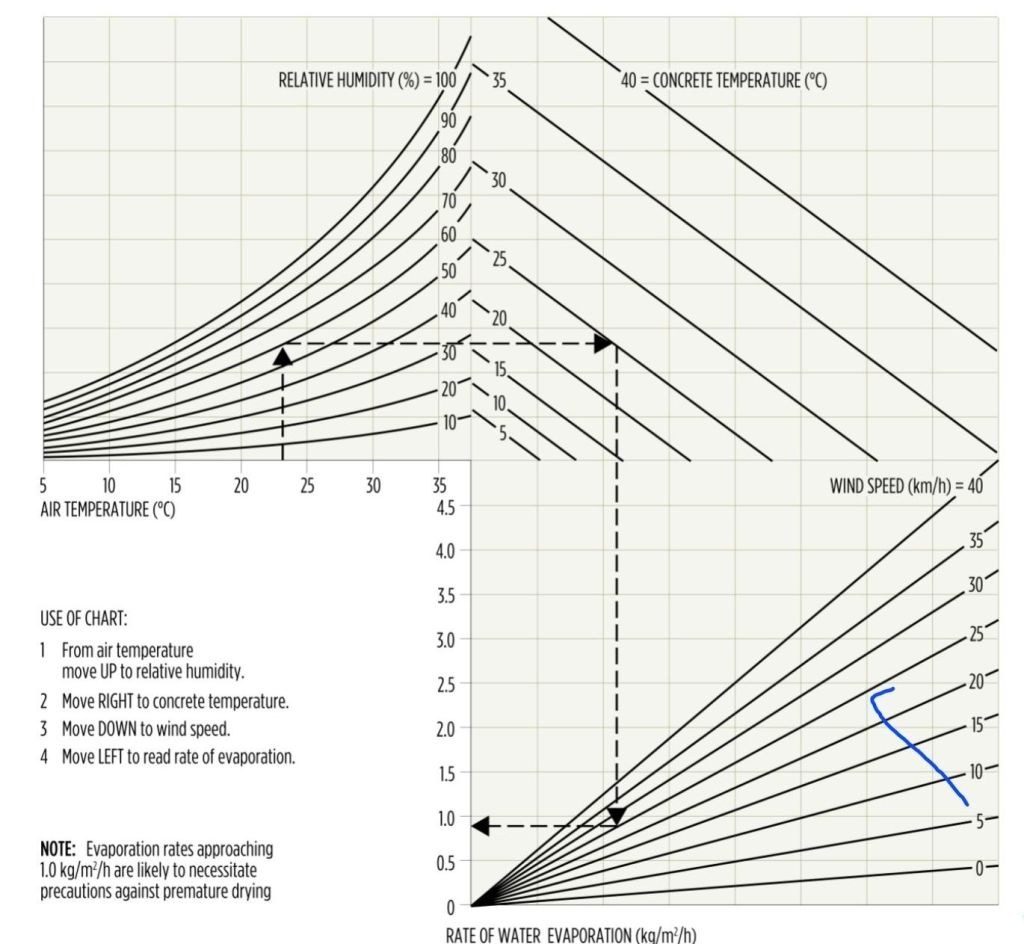
Elevated ambient temperature and wind raise surface evaporation rates. ACI guidance identifies an evaporation threshold of 1.0 kg/m²/hr beyond which plastic shrinkage risk and finishing problems escalate. Measures include chilled mixing water, shaded stockpiles, fogging, and windbreaks.
Cold weather
Low temperatures slow hydration and delay strength gain. Fresh concrete is vulnerable to freeze damage if its bulk temperature reaches 0°C during the first 24 hours. ACI 306R recommends preventing freezing until concrete attains approximately 3.5 MPa (500 psi). Use heated enclosures, insulated formwork or accelerators where required.
Humidity
High humidity lowers evaporation but in combination with rainfall causes surface washout and inconsistent curing, producing weak surface layers. Maintain controlled curing regimes once placement is complete to ensure surface integrity.
Water–cement ratio and strength sensitivity
Design w/c should be maintained; unplanned additions of water (from rain, contaminated aggregates, or washout) reduce ultimate compressive strength and durability. The illustrative chart below displays the inverse relationship commonly used in mix design sensitivity analysis.
Standards and normative guidance (selected)
Key standards that govern practices for concreting in adverse weather:
- ACI 305R-20 — Guide to Hot Weather Concreting
- ACI 306R-16 — Guide to Cold Weather Concreting
- ACI 308R-16 — Guide to External Curing of Concrete
- ASTM C94/C94M-23 — Ready-Mixed Concrete
- ASTM C309-19 — Liquid Membrane-Forming Compounds for Curing Concrete
- EN 206:2013+A2:2021 — Concrete: Specification, Performance, Production and Conformity
- AS 1379-2007 — Specification and Supply of Concrete
- AS 3600-2018 — Concrete Structures
Note: refer to the latest published editions of these documents for full prescriptive requirements and jurisdictional amendments.
Recommended site controls & prescriptive checklist
The following checklist is a concise, actionable set of controls for typical site operations:
- Pre-pour planning: Confirm forecast (hourly), prepare contingency for delay, verify drainage and overhead protection.
- Mix and materials: Order mix with correct design w/c; consider admixtures (retarders, accelerators, shrinkage reducers) as per project spec.
- Temperature control: For hot weather use chilled mixing water and shaded aggregates; for cold weather use heated mixing water, insulated forms or enclosures.
- Evaporation control: Use fogging, evaporation retardants or finishing aids when evaporation > 1.0 kg/m²/hr (ACI 305 guidance).
- Placement practice: Minimize drop height, avoid surface contamination from runoff, maintain continuous finishing regime where possible.
- Curing: Implement immediate curing strategy (wet curing, curing compounds per ASTM C309 or wet coverings) consistent with ACI 308R.
- QA & testing: Monitor in-situ temperature, measure slump on arrival, sample for compressive strength cylinders and record any weather-related anomalies.
Practical examples
Example A — Hot weather: Morning pour at 34°C, 15 km/h wind, RH 35% — reduce concrete temperature using chilled water, cover aggregates, use fogging during initial set, and apply curing compound immediately after finishing.
Example B — Cold weather: Nighttime pour with forecasted temperature near 0°C — use insulated blankets and heated enclosure, verify concrete temperature never drops below 5–10°C until 3.5 MPa is achieved.
Conclusion
Weather is a major variable in concrete quality control. Applying the standards and practical controls outlined here will reduce the incidence of early-age defects and long-term durability problems. Engineers should integrate weather risk into project QA plans, maintain accurate on-site measurement, and follow the prescriptive recommendations of normative documents.
References
ACI 305R-20 — Guide to Hot Weather Concreting
ACI 306R-16 — Guide to Cold Weather Concreting
ACI 308R-16 — Guide to External Curing of Concrete
ASTM C94/C94M-23 — Standard Specification for Ready-Mixed Concrete
ASTM C309-19 — Liquid Membrane-Forming Compounds for Curing Concrete
EN 206:2013+A2:2021 — Concrete: Specification, Performance, Production and Conformity
AS 1379-2007 — Specification and Supply of Concrete
AS 3600-2018 — Concrete Structures
Neville, A.M. (2011), Properties of Concrete, 5th Edition
Concrete Society Technical Report 30 (1999)



 Civil Insight
Leave a comment